
Proving a Charlotte store knew about a hazard before you fell depends on a legal concept called constructive knowledge, and the most powerful evidence for it is often sitting in the retailer’s own records.
When a store fails to follow its internal inspection schedule, and someone is hurt as a result, that failure can establish liability under North Carolina premises liability law regardless of whether any employee actually saw the spill or hazard before the fall.
Constructive knowledge means the property owner should have known about a dangerous condition because it existed long enough that a reasonable inspection would have found it.
It is the legal standard that applies when no one admits to seeing a hazard, and it is the standard that most slip and fall cases in Charlotte ultimately turn on. Proving it requires evidence, and that evidence frequently lives in documents the store generated itself.
A slip and fall lawyer in Charlotte who understands how to obtain, read, and argue from commercial inspection records approaches these cases with a fundamentally different toolkit than one treating them as straightforward accident claims.
Legal Solutions Are Just a Call Away
- Constructive knowledge is the central challenge: Most Charlotte slip and fall cases do not involve a store employee who admits to seeing a hazard. Proving the store should have known requires building a case from inspection records, timestamps, and internal protocols.
- Sweep logs are a critical evidence source: Retailers maintain internal inspection schedules, and the logs that document compliance with those schedules can prove whether a hazard was present long enough to trigger the owner’s duty to act.
- A store’s own policies can be used against it: When a retailer sets a 15 or 20-minute inspection interval and fails to follow it, that deviation from their own standard is evidence of negligence, independent of what any customer could see.
- Video timestamping corroborates paper records: Surveillance footage that shows when a hazard appeared and when, if ever, an employee passed through the area provides objective confirmation that sweep logs cannot account for alone.
- Preservation demands must go out immediately: Both sweep logs and surveillance footage are subject to routine deletion. Acting within hours of a serious fall preserves evidence that may be gone within days.
What Constructive Knowledge Means in a North Carolina Slip and Fall Case
North Carolina premises liability law requires an injured visitor to prove that a property owner either knew about a dangerous condition or should have known about it through reasonable care.
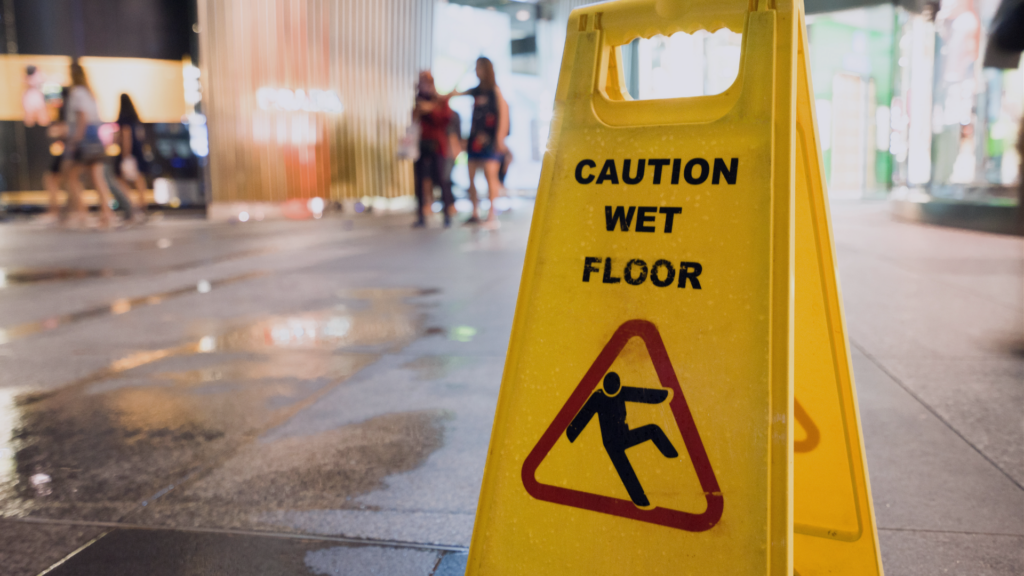
Actual knowledge means an employee saw the hazard. Constructive knowledge means the hazard existed long enough that a diligent inspection program would have found it.
Courts evaluating constructive knowledge consider how long the dangerous condition persisted before the fall. A spill that existed for two minutes before someone slipped presents a different legal picture than one that sat on the floor for 45 minutes while employees worked nearby.
The longer the hazard existed without correction, the stronger the argument that the property owner had a reasonable opportunity to find and fix it.
That timeline is where sweep logs become the centerpiece of the evidentiary analysis.
What Commercial Sweep Logs Are and Why Retailers Use Them
Major retailers, grocery chains, and large commercial properties maintain internal inspection programs as part of their standard operations. These programs typically require employees to walk designated areas of the store at regular intervals, checking for spills, debris, damaged flooring, and other hazards.
Each completed inspection is documented in a sweep log, sometimes on paper, sometimes digitally, with the time, the area inspected, and the name or ID of the employee who performed the check.
These logs exist for operational and liability management reasons. Retailers know that slip-and-fall injuries generate claims, and documented inspection programs provide a defense when a claim is filed.
The records meant to protect a store from liability can, when they reveal gaps or failures, become evidence of the negligence that caused an injury.
What a Sweep Log Typically Contains
The specific format varies by retailer, but most commercial sweep logs include several consistent elements.
| Field | What It Records | Why It Matters in Litigation |
|---|---|---|
| Timestamp | The time each inspection of a specific zone was completed | Establishes the interval between checks and whether the store met its own inspection schedule |
| Zone or area identifier | The section of the store covered by each inspection entry | Allows reconstruction of which areas were checked and when, pinpointing gaps near the fall location |
| Employee identifier | The name or employee number of the person who conducted the inspection | Relevant when depositions are taken and witnesses are identified during discovery |
| Condition notes | Any hazards found and corrective action taken, where required by store policy | Can document awareness of recurring problems in specific areas prior to the fall |
When these records are produced in litigation, they allow a Charlotte personal injury attorney to reconstruct a timeline of when each area of the store was last inspected before a fall occurred.
The 15-Minute Rule: How Inspection Intervals Establish Negligence
Many major retailers set inspection intervals of 15 to 20 minutes as part of their internal safety standards. That interval represents the store’s own judgment about how frequently its floors need to be checked to maintain safe conditions.
When a store establishes that standard and then fails to meet it, the deviation becomes evidence of negligence under North Carolina premises liability law.
The argument works like this: if a store’s own policy requires a zone inspection every 15 minutes and the sweep log shows the last recorded check before a fall occurred 45 minutes prior, the store has documented its own failure to meet the duty of care it set for itself.
A Charlotte premises liability attorney does not need to argue about what a reasonable retailer should do in the abstract. The store already answered that question in its own policy manual.
When the Log Shows Compliance But the Hazard Still Existed
Sometimes sweep logs show timely inspections right up to the moment of a fall. That documentation does not automatically defeat a claim. The relevant question becomes whether the inspection was actually performed as documented, whether the employee who signed off on the check actually covered the area where the hazard existed, and whether the hazard was visible and detectable during the reported inspection window.
This is where video evidence becomes essential to the analysis.
Video Timestamping and Its Role in Corroborating Sweep Log Evidence
Surveillance footage does something sweep logs cannot do alone: it shows what actually happened in a specific area of a store, independent of what any employee wrote down.
When footage and sweep logs are analyzed together, the combined picture is often more compelling than either source on its own. A thorough video analysis of a Charlotte slip and fall incident typically pursues three specific data points:
- When the hazard appeared: Footage showing the moment a spill occurred or a hazard came into existence establishes the starting point for the constructive knowledge analysis. A hazard that appears 40 minutes before a fall presents a fundamentally different legal situation than one that appeared two minutes prior.
- Whether employees passed through the area: Video showing store employees walking through or near the hazard area without stopping to investigate or correct it is direct evidence that the hazard was either visible and ignored or that the inspection was not performed as documented.
- The fall itself: Footage of the fall documents the conditions at the moment of impact and can refute attempts to minimize or recharacterize what occurred.
When a sweep log records an inspection of the area 12 minutes before a fall, but surveillance footage shows no employee entered that zone during the relevant window, the discrepancy speaks for itself.
How Charlotte Retailers Respond to Sweep Log Requests
When premises liability litigation proceeds in Mecklenburg County courts, sweep logs and related maintenance records become subject to formal discovery.
Retailers are required to produce the inspection documentation for the relevant area and time period. What those records show varies considerably by case.
Some retailers produce complete, clearly organized logs that support the defense that inspections were timely. Others produce logs with conspicuous gaps, altered timestamps, or inspection entries for areas that video footage shows were never actually checked.
In the most significant cases, retailers produce no logs at all for the period in question, which raises its own set of legal arguments about document retention and spoliation.

What Breach of Internal Policy Means for a Charlotte Premises Liability Claim
North Carolina premises liability law does not require a store to be perfect. It requires a store to act reasonably.
When a retailer has defined what reasonable means through its own internal policies and then failed to meet that standard, the argument for negligence is built on the store’s own documentation rather than on an external judgment about what it should have done.
This framing matters because it removes a common defense. Property owners frequently argue that a hazard was not reasonably foreseeable or that their general practices were adequate.
When a sweep log shows a 50-minute gap in a zone inspection program that the store’s own policy requires to run every 20 minutes, that general defense is difficult to sustain.
The North Carolina General Statutes and the standards applied in North Carolina courts recognize that property owners are held to the duty of care they owe their invitees.
When a store’s internal protocols define that duty more specifically than the general legal standard, those protocols become part of the evidentiary landscape.
FAQ for North Carolina Premises Liability Law and Sweep Log Evidence
Can I request sweep logs from a store without filing a lawsuit?
Pre-suit evidence requests are possible in some circumstances, but retailers are generally not required to comply without a legal obligation in place. A formal preservation demand from an attorney creates a stronger basis for retention, and formal discovery through a personal injury lawsuit is typically required to compel full production.
What if the store claims its sweep logs were lost or never existed?
Retailers that cannot produce inspection records they were legally obligated to retain may face arguments about spoliation of evidence, a legal concept that addresses the destruction or loss of relevant documentation. How that argument plays out depends on the specific facts and the circumstances of the document loss.
How far back do sweep logs typically go?
Retention policies vary by retailer. Some maintain logs for 30 days, others for longer periods. Once a claim is anticipated, a legal hold should require retention from that point forward. Logs from before the hold was implemented may or may not exist depending on the retailer’s standard practices.
Do smaller stores and local businesses maintain sweep logs?
Formal sweep log programs are more common in large retail chains than in smaller independent businesses. Smaller properties may rely on informal inspection practices that are harder to document. In those cases, other evidence sources such as employee testimony, prior incident reports, and general maintenance records take on greater importance.
Is a store automatically liable if its sweep log shows a gap before my fall?
A gap in the sweep log is significant evidence but not automatic proof of liability. The hazard must have existed long enough to fall within the inspection gap, and the connection between the failure to inspect and the injury must be established. A gap in documentation is a powerful starting point, not a final answer.
The Records That Tell the Real Story
A spill on a grocery store floor looks like an accident. A sweep log showing the last inspection of that area occurred 52 minutes before the fall, paired with footage of employees walking past the hazard without stopping, tells a different story.

That story is built from the store’s own records and serves as the foundation for proving constructive knowledge in Charlotte premises liability cases.
What documentation might exist from your fall that has not yet been requested or preserved?
Contact Maginnis Howard for a free consultation and let’s evaluate what the evidence may show.